
Pricing is one of the most sensitive questions for future wedding planners. It touches confidence, business strategy, client perception and profitability at the same time. Many new planners know they should charge professionally, but they struggle to translate their time and expertise into a clear fee.
In a premium wedding business, wedding planner pricing cannot be reduced to a simple template. The right fee depends on the type of service, the complexity of the wedding, the level of support offered, the market position of the brand and the planner’s ability to communicate value.
This guide offers a structured way to think about fees, packages and margins so future planners can move from hesitation to professional clarity.
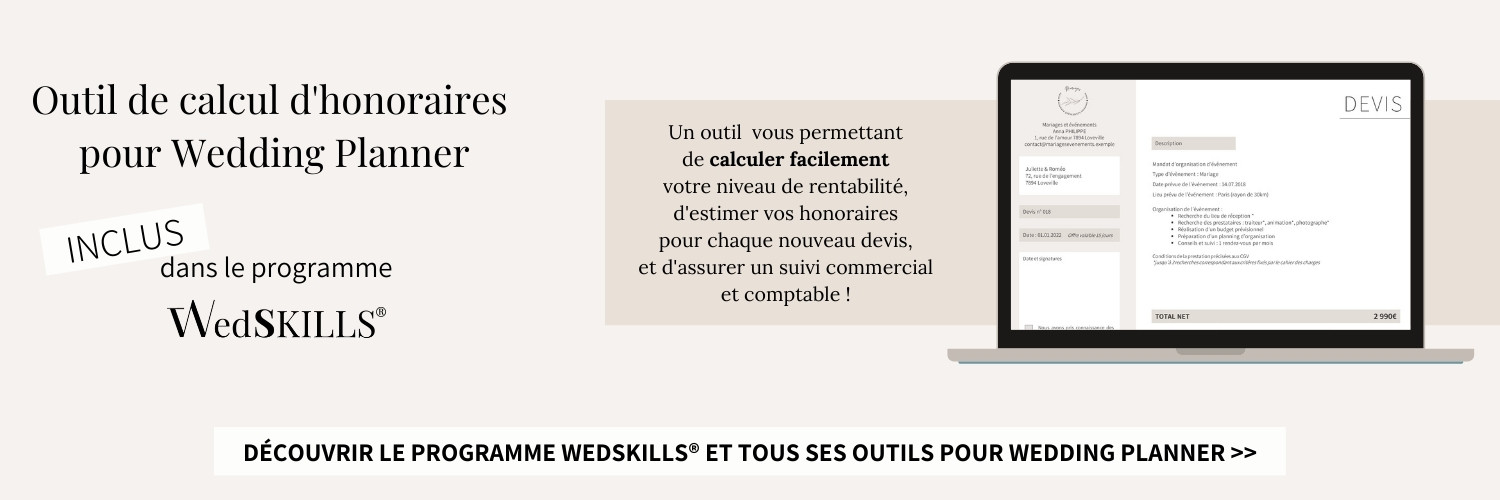
How should a wedding planner calculate pricing?
Wedding planner pricing should be calculated from time, expertise, operating costs, positioning, market expectations and desired profit margin. A professional fee is not a random percentage or an imitation of competitors. It is a business decision that must cover preparation, client communication, vendor coordination, wedding day presence, risk, taxes and the value of a structured planning method.
Why copying competitors is not a pricing strategy
Looking at competitors can help a planner understand a market, but it cannot define a profitable business model. Another planner’s price may reflect different costs, experience, services, location, team structure or personal financial needs.
A strong approach to wedding planner pricing begins inside the business. The planner must know how much time a service requires, what the fixed costs are, which tools are needed and what level of income the company must generate to remain sustainable.
What a planner’s fee really includes
Clients often see meetings, emails and the wedding day. They do not always see the invisible work: timeline design, vendor research, follow-up, budget monitoring, scenario planning, document preparation, problem-solving and mental availability.
The fee must include this invisible work. When it does not, the planner may appear affordable but will eventually feel exhausted, underpaid and unable to deliver the level of service promised.
Elements to include in a pricing calculation
- Estimated hours for each service phase, from onboarding to post-wedding follow-up.
- Fixed business costs such as software, insurance, accounting, marketing and education.
- Variable costs linked to travel, assistants, production and wedding day coordination.
- The level of expertise, method and responsibility carried by the planner.
- The positioning of the brand in relation to the target couple and market.
- Taxes, social contributions and a clear profit margin rather than only net survival.
The wider search intent behind the topic
In SEO terms, this topic naturally connects with wedding planner pricing, wedding business strategy, professional wedding planning, client experience, wedding day coordination and premium online education for the wedding industry. Used naturally, these expressions help the article answer several search intentions without sounding mechanical.
Balancing elegance with operational discipline
The most refined wedding businesses combine elegance with operational discipline. A beautiful brand may attract attention, but disciplined delivery keeps trust alive. This is why wedding planner pricing should always be connected to concrete systems, measured decisions and a clear client journey.
Connecting education with real professional standards
Professional standards become visible in small details: how a message is written, how a timeline is updated, how a client decision is recorded and how the next step is explained. Education should train these details because they are the daily proof of expertise.
Turning insight into a learner action plan
A learner can turn this article into action by choosing one concept, one document and one communication habit to improve this week. That small discipline is more useful than collecting endless advice. In the wedding industry, consistent application usually creates more progress than occasional intensity.
How this supports long-term growth
Long-term growth comes from making each season more intelligent than the previous one. The best professionals review their choices, refine their tools and keep learning. Over time, this creates a business that is easier to explain, easier to sell and easier to operate with confidence.
Why premium does not mean complicated
Premium work often feels simple from the client side because the complexity has been handled before it reaches them. The professional still needs depth, but the presentation should remain clear. This balance is especially important in the wedding industry, where clients want reassurance as much as expertise.
Creating a repeatable standard
A repeatable standard does not make a wedding feel less personal. It creates the stability needed to personalise the right details. When professionals define how they communicate, document, review and deliver, they have more freedom to adapt the experience without losing control.
The role of language and positioning
Language shapes how a service is perceived. Specific words such as planning timeline, wedding day coordination, vendor management, client journey and business model help readers understand the level of expertise behind the offer. This is valuable for SEO, but it is also valuable for trust.
Where many wedding businesses lose time
Time is often lost in unclear onboarding, scattered notes, late decisions and conversations that have to be repeated because the process is not documented. By connecting wedding planner pricing to better systems, a planner or supplier can protect energy and deliver a more consistent service through the entire season.
What this means for client experience
The client experience improves when the professional can translate complex work into simple steps. Couples do not need to see every operational detail, but they do need to feel that the process is controlled. Clear explanations, realistic expectations and organised follow-up create that feeling of calm expertise.
How to evaluate progress with wedding planner pricing
Progress should be evaluated through observable improvements, not only through motivation. A professional can look at whether documents are clearer, decisions are faster, clients ask fewer repeated questions and the business owner feels less dependent on improvisation. These indicators show that knowledge is becoming a working method.
A calmer way to build authority
Authority in the wedding industry does not require exaggeration. It grows through consistent education, honest communication, documented experience and a willingness to improve. A calm expert tone is often more persuasive than a dramatic promise, especially for couples and learners looking for high-level guidance.
From information to implementation
The strongest wedding businesses turn information into implementation. They create checklists, scripts, templates, review moments and client-facing explanations. This practical layer is what transforms a good idea into a repeatable standard and helps the professional grow without losing quality.
Why this matters for premium positioning
Premium positioning is not created by elegant words alone. It is created by reliability, specificity and the ability to explain the professional process behind a beautiful result. When clients understand how decisions are made, why timelines matter and where expertise protects them, the service becomes easier to trust.
What learners should take from this guide
For learners, the most important takeaway is to avoid consuming information passively. A course, article or resource becomes valuable when it changes the way a future professional thinks and acts. Take notes, compare the advice with your current habits and identify one decision that can be improved immediately.
How to use wedding planner pricing as a business filter
A useful way to apply wedding planner pricing is to treat it as a decision filter rather than an isolated subject. Each time a professional chooses a tool, a communication style or a service boundary, the question should be whether it makes the client journey clearer and the business more sustainable. This keeps the work aligned with both premium service and commercial reality.
Packages, custom quotes and premium positioning
Some planners sell fixed packages, while others prefer custom proposals. Both models can work when the scope is clear. Fixed packages are useful for readability; custom quotes are useful when weddings vary widely in size, destination, culture or complexity.
Premium positioning does not mean increasing prices without substance. It means aligning the fee with a deeper service: sharper communication, better planning documents, stronger vendor management and a more reassuring client experience.
How education improves pricing confidence
Many pricing problems are not mathematical. They come from uncertainty about the professional role. When a planner does not fully understand the value of their coordination, logistics and decision-making, it becomes difficult to defend a price.
A serious wedding planner course helps learners understand the full scope of the job. It gives them the language to explain their value and the structure to calculate fees without apology.
A healthier way to discuss money with couples
The most elegant pricing conversation is transparent and calm. The planner explains what is included, how the process works, what is outside the scope and how additional work will be handled. This protects the relationship before pressure appears.
Wedding planner pricing is not only about earning more. It is about creating the conditions for better work, better boundaries and a better experience for the couple.
Further reading and useful resources
The following resources are connected to the topic and keep the original article’s useful references available on meaningful SEO anchors:
- difference between wedding planner and full-service wedding organizer
- wedding planner career guide
- wedding planner business plan model
- wedding planner market research guide
- marketing persona definition
- WedSKILLS wedding planner program
- wedding management tools and software
- WedMANA wedding management method
- professional wedding planner course
FAQ
What is the best pricing model for a wedding planner?
There is no single best model. A planner can use fixed packages, percentage-based fees, flat fees or custom quotes, as long as the pricing covers time, costs, risk and profit.
Should new wedding planners charge low prices?
New planners may start with accessible offers, but prices should still reflect the real amount of work. Charging too little can damage confidence and sustainability.
How can a planner explain high fees to couples?
The planner should explain the scope, process, deliverables, time commitment and level of responsibility. Value becomes clearer when the service is described precisely.
What costs are often forgotten in wedding planner pricing?
Software, insurance, accounting, travel, assistants, education, marketing, taxes and unpaid preparation time are often underestimated.
Can a wedding planner course help with pricing?
Yes. A strong course helps future planners understand their role, calculate fees, position their offer and communicate value professionally.