
A wedding business often begins with a creative desire: planning elegant celebrations, designing beautiful atmospheres or supporting couples through an emotional milestone. Yet before launching, every future professional needs to understand the market they want to serve.
A market study is not an academic exercise. It is a decision tool. It helps a wedding planner or designer identify demand, competitors, pricing habits, client profiles, local opportunities and the conditions required to build a sustainable business.
Why a market study matters before launching
Many wedding entrepreneurs want to start with a logo, website or Instagram account. Those tools are important, but they should be guided by market knowledge. Without research, the business may target the wrong couples, offer services that are hard to sell or price packages without understanding local expectations.
A specialized wedding business course can help future professionals structure this stage. The goal is not to remove intuition; it is to support intuition with evidence. A refined brand becomes much stronger when it responds to a real market opportunity.
Step 1: define the market and geographical area
The first step is to decide what market is being studied. A wedding planner in a large city does not face the same conditions as a designer working in rural venues or a destination wedding consultant serving international couples. Geography, travel radius, venue density and local purchasing power all influence the project.
Define your catchment area clearly. It may be a city, a region, a destination, a language market or a specific type of venue. Then identify how many weddings, venues, suppliers and potential clients exist in that zone. Official data sources such as INSEE can support demographic and economic research in France.
Step 2: understand future couples
A useful market study goes beyond counting weddings. It studies the people behind the demand. Who are the couples? How old are they? Where do they live? What kind of wedding do they want? What problems do they want solved? What level of support are they ready to pay for?
This research can include questionnaires, interviews, wedding forums, venue conversations, supplier feedback and social media observation. The objective is to create a realistic client profile, not a fantasy. Premium positioning requires a deep understanding of what clients value and fear.
Look at both rational and emotional needs
Couples buy planning services for practical reasons: lack of time, distance, complex logistics, supplier sourcing or wedding day coordination. They also buy for emotional reasons: reassurance, confidence, taste, calm and the desire to feel guided. A strong market study captures both.
Step 3: analyze existing agencies and competitors
Competitor research should be respectful and precise. Identify local wedding planners, designers, coordinators, venue planners and turnkey organizers. Study their services, price signals, tone, portfolio, reviews, website structure and positioning. The goal is not to copy them; the goal is to understand where your own offer can be clearer or stronger.
This analysis also supports the future wedding business plan. The business plan needs assumptions about revenue, expenses, pricing and market opportunity. A market study gives those assumptions a more credible foundation.
Step 4: organize the information into strategic choices
Research becomes valuable only when it leads to decisions. After collecting data, group insights into opportunities, risks, target clients, service ideas, pricing ranges and communication angles. This stage transforms scattered notes into a strategic diagnosis.
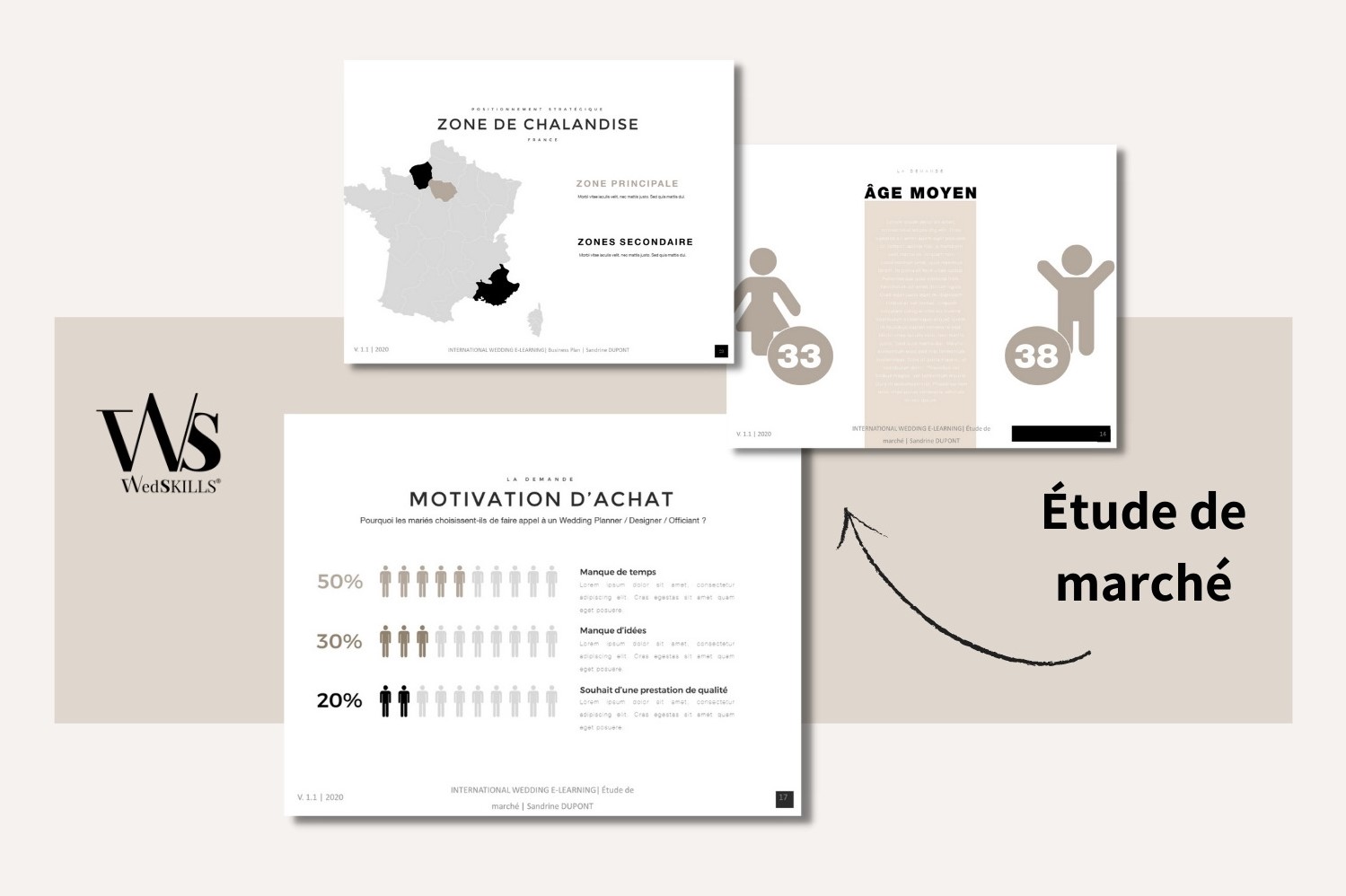
The exclusive WedSKILLS market study template can support this type of structure by giving future wedding entrepreneurs a more usable structure. A template is useful when it forces clear thinking instead of simply filling pages.
Step 5: estimate revenue and decide how to launch
The final stage is to estimate whether the business model can work. How many weddings are needed to reach a realistic income? How many enquiries are required to sign those weddings? What is the average service fee? Which costs will appear before the first season?
This is where future professionals should be honest. A beautiful idea may need a different positioning, a slower launch, additional education or a more focused offer. The market study is not there to discourage ambition; it is there to make ambition more solid.
For a complete launch sequence, it is useful to connect the study with the broader steps to create a wedding business. Learners who want structured support can also explore WedSKILLS business guidance as part of a more complete entrepreneurial path.
A concise market study structure
- Market definition: services, location, client segment and wedding type.
- Demand research: couples, budgets, expectations and pain points.
- Competitor analysis: agencies, venues, packages, pricing and positioning.
- Opportunity diagnosis: gaps, risks, differentiators and service ideas.
- Financial assumptions: fees, volume, costs, seasonality and launch capacity.
- Decision: launch, adjust, specialize, delay or deepen preparation.
How to use the market study after the launch
A market study should not disappear once the business is created. It can be reviewed every season to compare assumptions with real enquiries, signed contracts and client feedback. This turns the document into a living business tool.
For example, if the study predicted strong demand for full planning but most enquiries request wedding day coordination, the offer may need adjustment. If a premium service attracts interest but few signatures, pricing, consultation scripts or proof of value may need refinement.
This continuous review supports smarter growth. The wedding market changes with budgets, venues, social trends and client expectations. A professional who keeps learning from the market can adapt without losing brand direction.
Common mistakes to avoid
A weak market study often starts with conclusions instead of questions. It assumes that every couple wants the same service, that competitors are either irrelevant or impossible to challenge, and that pricing can be guessed from personal preference.
A stronger approach is evidence-based. It accepts what the data reveals, then uses creativity to design a clearer positioning, a more relevant offer and a launch rhythm that fits the market.
Turning research into positioning
The strongest outcome of a market study is not a document; it is a positioning decision. The future planner may discover that the local market needs high-end coordination, bilingual destination support, design-led planning or clear packages for intimate weddings.
Once that positioning is chosen, it should influence the website, service names, SEO keywords, pricing, portfolio goals and networking strategy. Research becomes visible through sharper business decisions.
This is how a market study supports conversion. Prospects feel that the offer is specific, relevant and built for their situation, rather than a generic promise to organize any wedding.
A market study is also a confidence tool. When a future planner understands the numbers, competitors and target clients, business decisions feel less emotional and more strategic.
This confidence is visible during consultations. A professional who knows the market can explain pricing, service boundaries and value with more precision, which supports both conversion and long-term credibility.
The research should include supplier conversations whenever possible. Florists, venues, photographers and caterers often understand client behavior before it appears in public statistics. Their perspective can reveal budget habits, seasonal peaks and common planning challenges.
A market study should also identify barriers to entry. These may include strong competitors, limited venue access, low local budgets, language requirements or a lack of professional network. Naming those barriers helps create a more realistic launch plan.
SEO planning can begin from the market study. If research shows that couples search by location, service type or problem, the website can be structured around those search patterns from the start.
Finally, the study should lead to a decision calendar. The future professional can decide when to finish education, when to build documents, when to publish the website and when to begin accepting clients.
The study can also reveal whether a niche is strong enough. For example, a market may support destination elopements, luxury full planning, eco-conscious design or bilingual coordination, but each niche requires evidence before investment.
A well-written conclusion should state what the professional will do next. Research without a decision is incomplete; the purpose is to guide the launch with confidence.
Market research should be honest about personal capacity as well. A solo planner cannot manage unlimited weddings, and a designer may need suppliers, assistants or studio time to deliver certain services.
The projected revenue should therefore be compared with operational reality. How many clients can be served well at the same time? How much time does each service require? Which months will be busiest?
These questions prevent overpromising. A wedding business becomes more sustainable when the market opportunity is aligned with the professional’s real capacity to deliver beautifully.
Frequently asked questions
Is a market study necessary for a wedding planner?
Yes. It helps validate the opportunity, understand clients, analyze competitors and avoid launching with assumptions that do not match the local market.
How long should a wedding business market study be?
It should be long enough to support decisions, but not so long that it becomes theoretical. A clear, structured document with evidence and strategic conclusions is more useful than a large file with no direction.
What data should be included?
Include location, number of weddings, client profiles, venue types, competitors, pricing signals, supplier ecosystem, demand trends and financial assumptions.
How does a market study connect to a business plan?
The market study provides the evidence. The business plan turns that evidence into strategy, revenue assumptions, positioning, services and launch actions.