Course, Workshop, Masterclass, Conference, Coaching or Consulting: What Is the Difference?
A clear explanation of the different learning formats used in the wedding industry, from full programs to workshops, masterclasses, coaching, and consulting.
PublishedRead 10 minBy Anne-Marie MECHERI
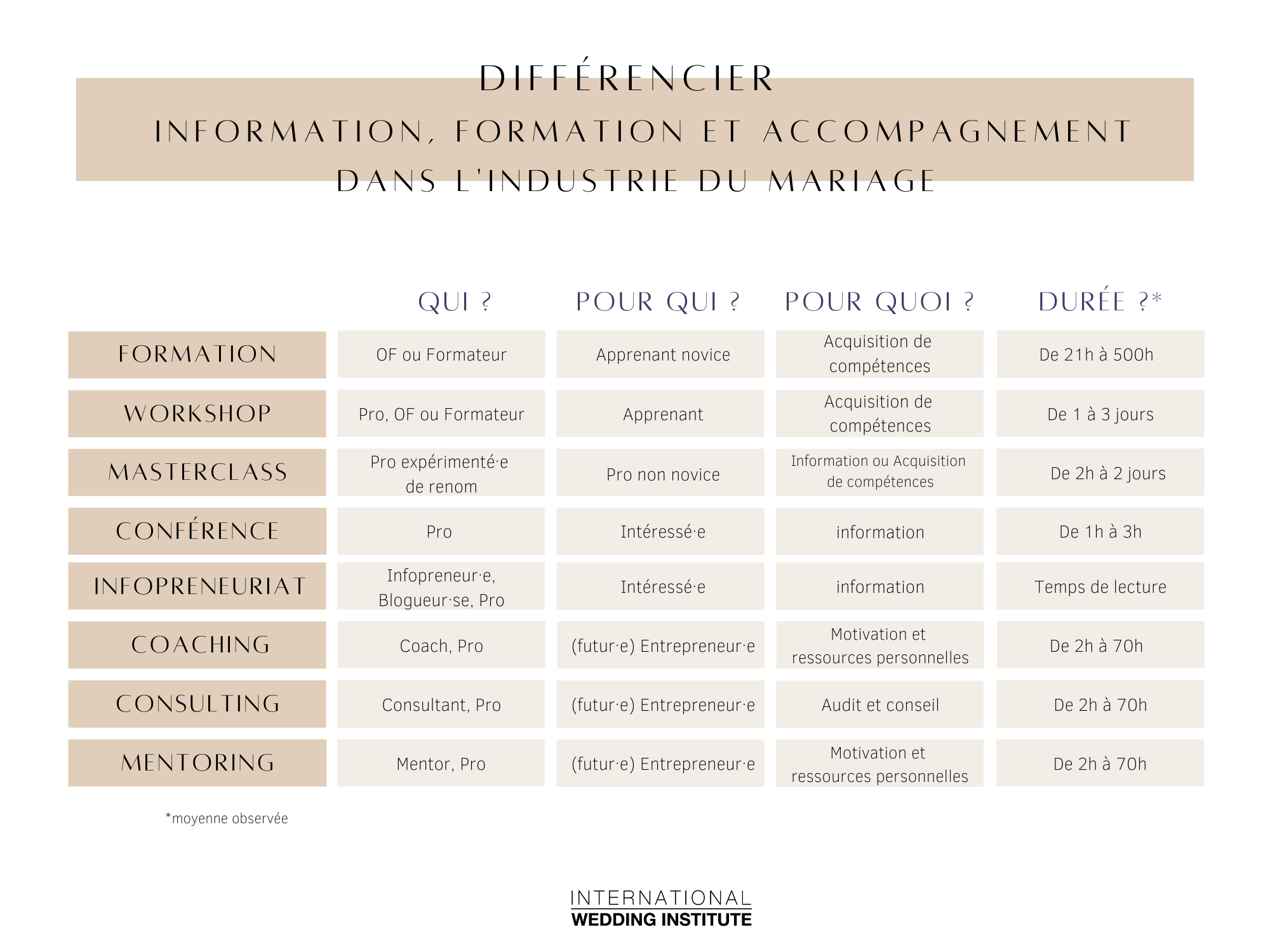
The vocabulary of professional learning can be confusing, especially in a young and fast-evolving sector like the wedding industry. People often use the words course, workshop, masterclass, conference, coaching, and consulting as if they were interchangeable, but each format has a different purpose.
Understanding the difference matters because the right format can accelerate learning, while the wrong format can create frustration. A future wedding planner who needs foundations will not get the same value from a one-hour conference as from a structured course. A business owner who already knows the profession may not need a beginner program, but may benefit from consulting on pricing, branding, or operations.
How do you choose between a course, workshop, masterclass, conference, coaching, and consulting?
Choose the format according to the result you need. A course builds structured knowledge over time. A workshop develops a specific practical skill. A masterclass offers expert insight on a focused topic. A conference inspires or informs a wider audience. Coaching supports personal progress and decision-making. Consulting provides expert recommendations for a specific business or operational problem.
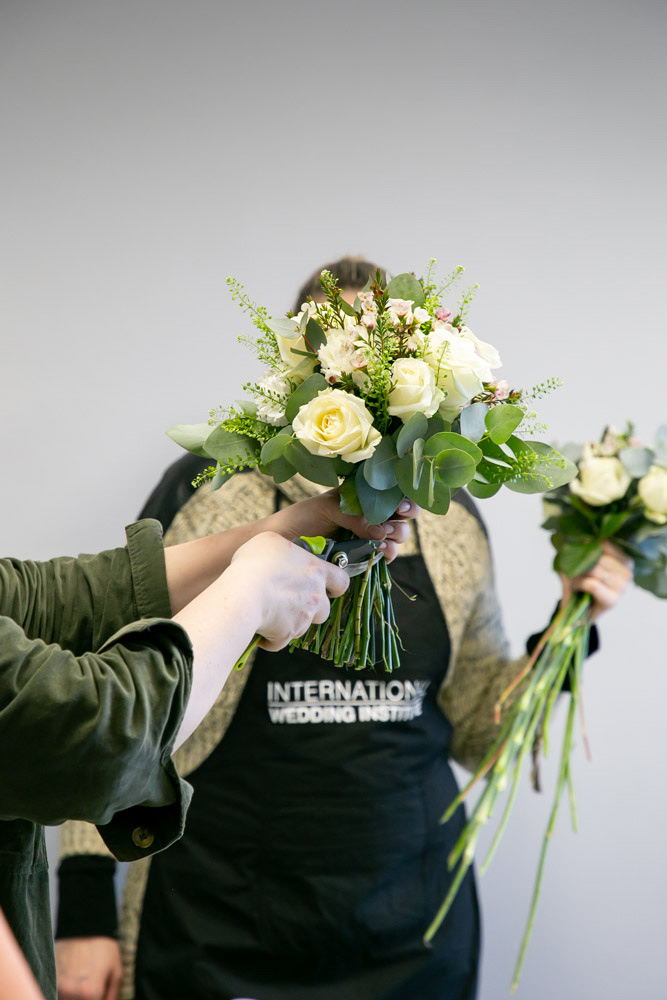
Wedding course workshop masterclass conference coaching and consulting explainedFloral wedding workshop and practical learning for wedding professionals
This distinction is also useful for wedding educators. Choosing the right words protects the quality of the offer and helps learners understand what they are really buying, how much involvement is expected, and what kind of transformation is realistic.
Why learning formats are often confused
The wedding education market is still young compared with more established professional sectors. Many experts began by sharing experience informally, then created workshops, online courses, mentoring sessions, or conferences. As the market grew, the vocabulary became blurred.
This confusion is not necessarily malicious. Sometimes a passionate expert uses the word masterclass because it sounds elegant, even though the offer is closer to a webinar. Sometimes a workshop is announced, but the experience is actually a lecture without practice. Sometimes coaching is used to describe consulting, even though the two relationships are very different.
For learners, the consequence can be disappointing. They may expect a complete method and receive only inspiration. They may expect individual guidance and receive a group presentation. They may expect hands-on practice and receive theory. Clear terminology prevents those misunderstandings.
In a premium wedding education environment, words should be chosen with care. They define the promise, the rhythm, the level of interaction, and the responsibility of both the educator and the learner.
The main learning formats explained
A course or program builds a complete foundation
A course is usually the most structured format. It is designed to guide learners through a sequence of concepts, skills, exercises, and professional standards. In the wedding industry, a course may cover wedding planning, wedding day coordination, wedding design, ceremony creation, business setup, client communication, and vendor management.
A workshop focuses on practice
A workshop should normally involve doing something. It may focus on floral design, table styling, mood boards, sales scripts, ceremony writing, budget tools, or planning timelines. The value of a workshop lies in application: participants leave with a skill, a draft, a method, or a better professional gesture.
A masterclass shares expert-level insight
A masterclass is usually shorter and more focused than a full course. It is valuable when an expert reveals a method, a perspective, or a high-level approach to a specific topic. It can be powerful, but it is not a complete professional education by itself.
A conference informs or inspires
A conference is generally designed for a larger audience. It can introduce a subject, share a story, analyze a trend, or spark motivation. It is useful, but it rarely creates deep operational skill unless it is combined with exercises or follow-up learning.
Coaching and consulting serve different needs
Coaching helps a person clarify decisions, overcome blocks, and move forward through guided questioning and accountability. Consulting is more directive. A consultant analyzes a situation and gives expert recommendations, for example on a wedding business offer, pricing structure, communication strategy, or operational process.
How to avoid choosing the wrong format
Start by identifying the gap. Do you lack foundations, practice, confidence, strategic direction, or expert diagnosis? The answer will make the right format much clearer.
If the gap is foundational, choose a course. If the gap is technical, choose a workshop. If the gap is inspiration or trend awareness, attend a conference or masterclass. If the gap is personal clarity, coaching can help. If the gap is a business problem that needs expertise, consulting may be more appropriate.
Also look at the promise. A professional offer should clearly state what is included, how long it lasts, whether there are exercises, whether support is provided, and what the learner can realistically expect after completing it.
For SEO and semantic clarity, this subject naturally connects wedding course, wedding workshop, wedding masterclass, wedding coaching, wedding consulting, wedding planner training, e-learning, mentoring, professional development, and wedding business strategy.
Which format is best for future wedding planners?
For someone at the beginning of a career change, a structured course is usually the most coherent starting point. It creates a foundation before the learner invests in narrower experiences. Without that foundation, it is difficult to evaluate whether a masterclass or workshop is truly relevant.
Once the foundations are in place, workshops become extremely useful. A learner can then practice specific skills: building a mood board, writing a service proposal, designing a wedding day schedule, creating a ceremony outline, or organizing vendor communication.
Masterclasses can enrich the journey by opening a more refined perspective. A specialist may reveal how she approaches luxury client experience, destination logistics, editorial styling, or brand storytelling. These insights are valuable when learners already understand the basics.
Coaching and consulting often become more relevant when a professional has a real project, a brand, a service, or a client situation to analyze. At that point, personalized guidance can accelerate progress because the questions are concrete.
A smarter way to invest in wedding education
The most elegant strategy is to build learning in layers. Begin with a strong base, then add focused experiences according to your goals. This prevents the common mistake of collecting scattered content without creating a coherent professional identity.
A future wedding planner can start with a complete program, then take a workshop on wedding day coordination, a masterclass on client experience, and consulting when the agency offer needs refinement. A future wedding designer might combine a design course, floral workshops, portfolio guidance, and brand coaching.
The question is not which format is superior. The question is whether the format matches the learner’s current need. A premium learner knows how to choose with intention rather than impulse.
When the terminology is clear, the wedding education market becomes more transparent. Learners feel respected, educators communicate more honestly, and professional development becomes a strategic investment instead of a confusing collection of attractive names.
How to turn this insight into a confident next step
The most effective way to use this article is to translate it into a concrete professional decision. In the context of wedding course vs workshop, clarity begins when a future wedding professional can name the skill to develop, the service to refine, and the type of client experience they want to create.
Start by writing a short personal brief. What do you already understand? What still feels uncertain? Which documents, examples, or exercises would make the subject easier to apply? This turns reading into action and prevents the common mistake of collecting ideas without building a professional method.
Then connect the topic to a real business situation. Imagine a first client inquiry, a first discovery call, a vendor conversation, a service proposal, or a wedding day challenge. Ask yourself how the concepts in the article would change the way you speak, organize, decide, or reassure the couple.
Premium wedding education is most powerful when it creates visible habits. Better questions, clearer boundaries, more precise vocabulary, stronger timelines, and more intentional communication all become signs of professionalism long before a brand has years of experience.
This is also where a structured course or guided program can make the transition smoother. Instead of trying to assemble the profession from scattered information, the learner can move through a coherent path, revisit difficult points, and transform each topic into a usable tool for a future wedding business.
The next step does not need to be dramatic. It can be as simple as clarifying your goal, choosing one skill to strengthen this week, reviewing your notes, or comparing your current project with the standards described here. Small, consistent decisions are often what create the most elegant professional growth.
The standard behind a premium wedding career
A premium wedding career is built through repeated attention to detail. With wedding course vs workshop, the visible result may be a better decision, a clearer service, or a more confident business direction, but the invisible work is just as important: discipline, research, self-review, and the ability to improve without losing elegance.
This standard matters because couples do not only buy a task. They buy reassurance. They want to feel that the professional in front of them understands the emotional weight of the event, the financial commitment involved, and the level of coordination required to protect the experience.
For learners, that means every topic should be connected to client trust. A lesson about terminology improves trust because it creates clearer explanations. A lesson about timelines improves trust because it reduces uncertainty. A lesson about business positioning improves trust because the offer becomes easier to understand.
The strongest professionals keep refining their judgment. They do not rely only on charm, intuition, or creativity. They learn how to document, compare, prepare, and communicate. This is what separates a pleasant service provider from a truly reliable wedding professional.
When a future planner, designer, or officiant studies with this mindset, the learning process becomes more strategic. Each article, course module, exercise, or conversation contributes to a broader professional identity, one that can support both beautiful celebrations and a sustainable business.
Further reading and useful resources
The original article connected this topic to several useful resources. They remain included here on relevant professional anchors so the article keeps its editorial and SEO value.
No. A course is usually more structured and complete, while a masterclass is focused on a specific topic or expert perspective.
What is the main difference between coaching and consulting?
Coaching supports reflection, decision-making, and personal progress. Consulting gives expert analysis and recommendations for a specific business or operational challenge.
Should a beginner choose a workshop first?
A workshop can be useful, but beginners often benefit more from a structured course first because it gives context to the practical skill being taught.
Can a conference replace wedding planner training?
A conference can inspire and inform, but it rarely replaces a complete program that teaches methods, documents, and professional standards.
How can I recognize a serious learning offer?
Look for clear objectives, transparent format, realistic promises, professional vocabulary, and a direct explanation of what the learner will practice or receive.
Continue exploring the blog
Return to the IWI blog to read more resources for wedding planners, wedding designers and modern wedding professionals.